FDA 510(k) vs EU MDR CE Marking: A Comparative Guide
Barry Keenan
CTO & Managing Partner · 20 janvier 2026 · 9 min read
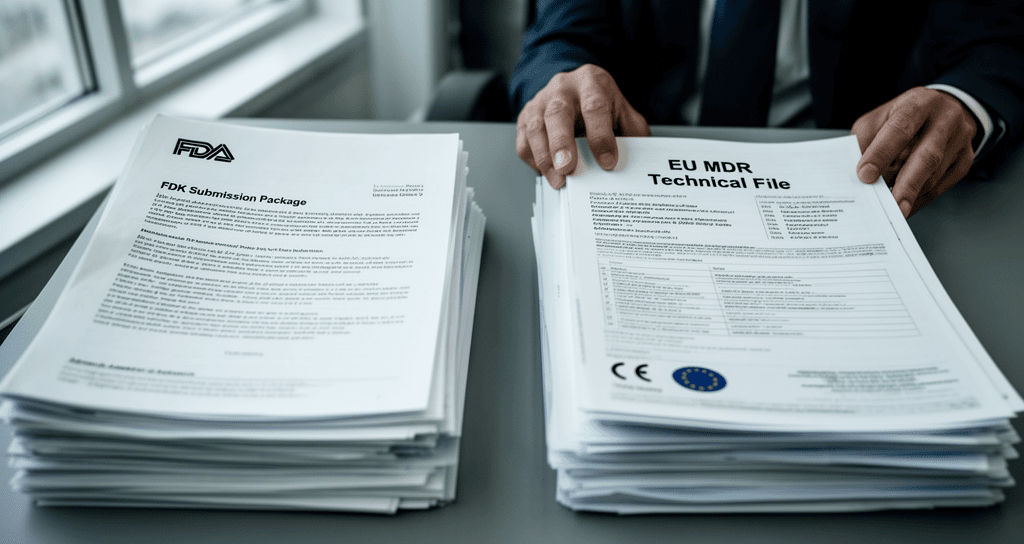
For medical device manufacturers seeking global market access, the United States and the European Union represent the two largest and most influential regulatory markets. However, the pathways to market authorization in each jurisdiction differ substantially in philosophy, structure, and documentation requirements. Understanding these differences is essential for developing an efficient dual-market regulatory strategy that avoids duplication of effort and leverages documentation synergies.
The FDA 510(k) pathway is predicated on the concept of substantial equivalence. A manufacturer must demonstrate that their device is substantially equivalent to a legally marketed predicate device in terms of intended use and technological characteristics. If differences exist in technology, the manufacturer must show that these differences do not raise new questions of safety and effectiveness, typically through performance testing. The 510(k) is a premarket notification, not an approval. It does not require clinical data in many cases, though the FDA may request clinical studies if bench and animal testing are insufficient to demonstrate equivalence.
EU MDR CE marking, by contrast, follows a conformity assessment model. Rather than demonstrating equivalence to an existing device, the manufacturer must demonstrate that the device meets the General Safety and Performance Requirements (GSPR) laid out in MDR Annex I. This includes providing sufficient clinical evidence per Article 61, which may come from clinical investigations, clinical evaluation of equivalent devices, or published literature. For Class IIa and above, a Notified Body must be involved in the conformity assessment, examining the technical documentation, quality management system, or both, depending on the conformity assessment route chosen.
One of the most significant differences lies in clinical evidence requirements. The FDA 510(k) pathway often allows manufacturers to rely primarily on bench testing and biocompatibility data, with clinical data required only when performance questions cannot be answered through non-clinical means. The EU MDR, however, requires a Clinical Evaluation Report (CER) for all device classes. The CER must be based on a systematic review of clinical data, including data from clinical investigations, published literature, and post-market experience. Furthermore, claiming equivalence to another manufacturer's device under MDR is substantially more restrictive than under the 510(k) framework. MDR Article 61(5) requires a contract with the equivalent device manufacturer granting access to their technical documentation, which is rarely achievable in practice.
Documentation structure differs markedly between the two systems. The FDA 510(k) submission is a focused document, typically structured around device description, predicate comparison, performance testing, biocompatibility, software documentation (if applicable), and labeling. It is submitted directly to the FDA for review. The MDR technical documentation, governed by Annex II and Annex III, is a comprehensive file that must cover the entire device lifecycle: design and manufacturing information, GSPR compliance, benefit-risk analysis, product verification and validation, clinical evaluation, and post-market surveillance planning. This documentation is not submitted to a central authority but must be available for review by the Notified Body and competent authorities at any time.
Timeline expectations also differ significantly. A traditional FDA 510(k) review has a statutory 90-day review clock, though in practice the total time from submission to clearance, including any additional information requests, typically ranges from 4 to 12 months. The EU MDR conformity assessment timeline is less predictable. With current Notified Body backlogs, manufacturers should plan for 12 to 24 months from initial Notified Body engagement to certificate issuance. This assumes that the technical documentation is substantially complete at the time of submission. Manufacturers who submit incomplete documentation may face substantially longer timelines.
Quality management system requirements also diverge in important ways. The FDA requires compliance with 21 CFR Part 820, the Quality System Regulation (QSR), which is being updated to align more closely with ISO 13485. The EU MDR requires a quality management system that meets the requirements of the applicable conformity assessment annex (typically Annex IX or Annex XI), with ISO 13485:2016 serving as the harmonised standard. While both frameworks share common principles of design controls, risk management, and corrective and preventive actions (CAPA), the specific requirements and audit approaches differ. Manufacturers operating in both markets should build a unified QMS that satisfies both frameworks, using ISO 13485 as the foundation.
Post-market requirements represent another area of divergence. The FDA requires manufacturers to submit Medical Device Reports (MDRs) for serious injuries, deaths, and certain malfunctions. The EU MDR imposes more extensive post-market surveillance obligations, including PMS plans, PMS reports or PSURs (depending on device class), PMCF studies, trend reporting, and vigilance reporting through the manufacturer incident report (MIR) process. The EU framework treats post-market surveillance as a continuous feedback loop that informs the ongoing clinical evaluation and risk management process.
Software-specific considerations add another layer of complexity. The FDA recognizes IEC 62304 as a consensus standard and requires software documentation proportionate to the level of concern (Minor, Moderate, Major). The EU MDR similarly references IEC 62304, but the intersection with cybersecurity requirements (addressed through MDCG 2019-16 and the forthcoming harmonisation of IEC 81001-5-1) means that software manufacturers must address a broader range of cybersecurity-specific documentation requirements for the EU market. Both jurisdictions are increasing their scrutiny of AI/ML-enabled devices, with the FDA's Predetermined Change Control Plan framework and the EU's evolving guidance on AI in medical devices.
For manufacturers planning a dual-market strategy, we recommend building your regulatory documentation from a shared foundation. Use ISO 13485 as your QMS baseline, ISO 14971 for risk management, and IEC 62366-1 for usability engineering. Structure your Design History File to capture the evidence needed for both the 510(k) substantial equivalence argument and the MDR GSPR compliance demonstration. Invest in a comprehensive clinical evidence strategy early, as the CER requirements under MDR are the more demanding of the two and clinical data generated for MDR purposes can typically be leveraged for FDA submissions. This integrated approach reduces duplicated effort and ensures consistency across your regulatory submissions.
Barry Keenan
CTO & Managing Partner
Rédigé par Barry Keenan chez Swiss MPC.
Découvrez nos services
Articles associés











Prêt à accélérer votre conformité réglementaire ?
Planifiez une consultation gratuite avec nos experts réglementaires seniors
Réponse généralement sous 24 heures